Insights · UK guide
Do you need a guide in Egypt? Honest answer
Mostly yes – and not for the reasons you'd think. The guide isn't there to recite dates. The guide is there to handle the tickets, the touts, the taxis, the prayer timings, and to make the site you're looking at mean something. The cost is small relative to the trip.
Updated 18 May 2026 · Reviewed by Discovery Tours Egypt editorial team
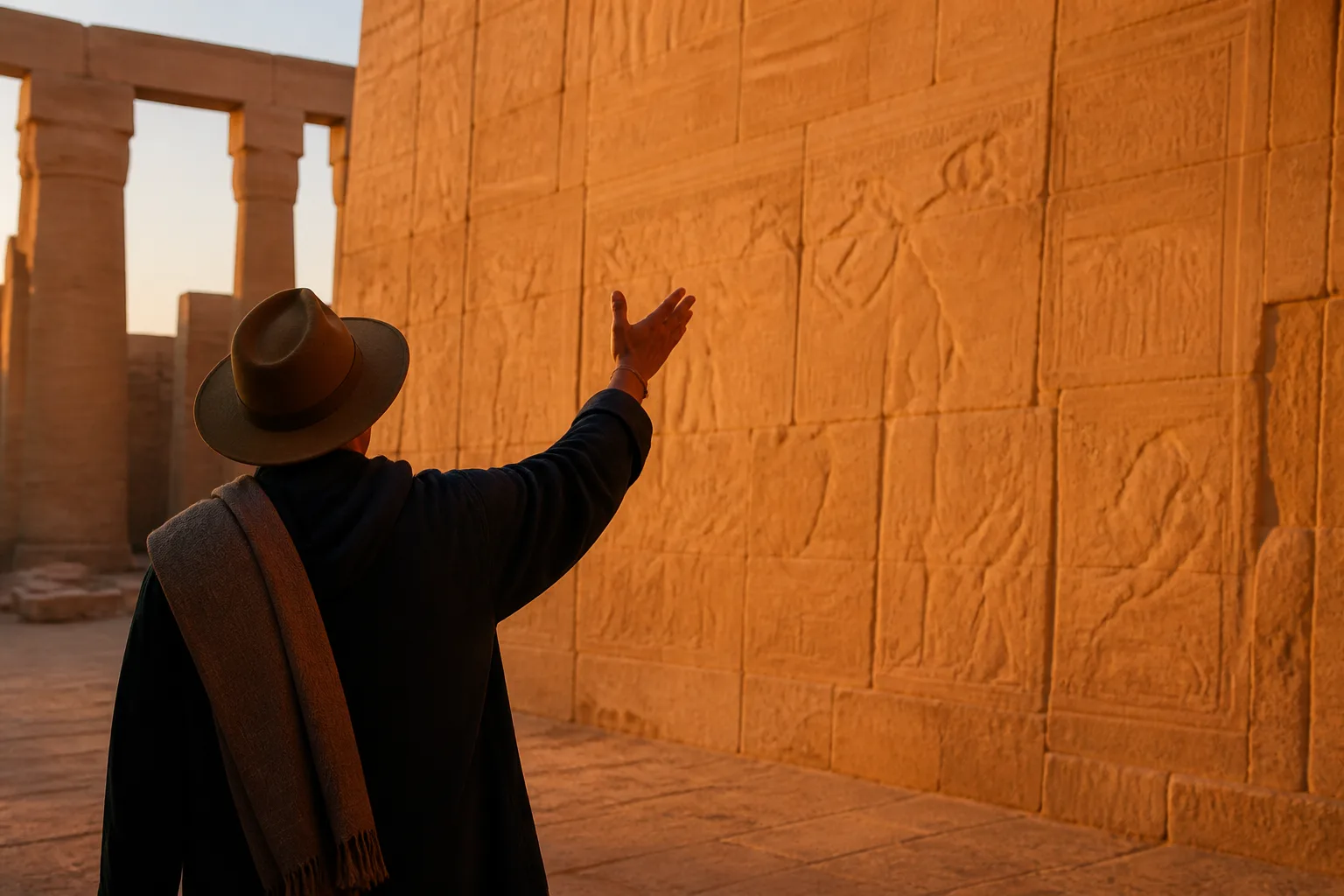
- Private licensed Egyptologist
- £90–135 per day in 2026
- Driver + air-conditioned vehicle
- £60–90 per day
- Where a guide is essential
- Valley of the Kings, Karnak, Egyptian Museum, Abu Simbel
- Where you can DIY
- Cairo modern districts, Khan el-Khalili shopping, Red Sea resorts
What an Egyptologist guide actually does (it's not the dates)
A licensed Egyptologist in Egypt has done a 4-year university degree in Egyptology and passed government licensing exams. They speak fluent English (or French / German / Italian / Spanish / Arabic). They know the monuments – but more importantly, they handle the practical layer:
- **Ticketing.** Multi-layer entry – Valley of the Kings is one ticket for the standard tombs, separate tickets for Tutankhamun, Seti I, Ramesses VI. Your guide buys them all without you queueing.
- **Touts.** At every major monument the on-site 'helpers' want £4 to point at a hieroglyph and £15 to take your camera and lie down with you. A guide blocks all of this.
- **Pacing.** Karnak alone is 100 hectares. Without a guide you'll either rush past the important reliefs or spend 90 minutes lost. A good guide gets you the headline 25% of what matters in 90 minutes.
- **Context.** This is the actual value. The Hatshepsut female-pharaoh story, the Akhenaten religious-revolution moment, the Tutankhamun-was-a-minor-pharaoh-but-his-tomb-survived footnote – these turn ruins into a story you'll remember.
Where you genuinely need a guide
1. **Valley of the Kings.** The tombs themselves have minimal signage and no in-tomb explanation. Without a guide you'll see colourful walls without context. 2. **Karnak Temple.** The biggest religious building ever made. Without a guide you'll wander, look up at the columns and leave. 3. **The Egyptian Museum (or Grand Egyptian Museum).** Tens of thousands of objects, sparse English labelling. A guide picks the 30 things that matter and explains them in 90 minutes. 4. **Abu Simbel.** The two temples make sense only when you understand the relocation story and Ramesses II's PR campaign – a guide adds 60% to the value. 5. **Coptic / Islamic Cairo.** The Hanging Church, Ben Ezra Synagogue, Sultan Hassan, Al-Azhar – historically dense, navigationally confusing, requires local context.
Where you can genuinely DIY
- **Khan el-Khalili shopping evening.** Just walk it, haggle, drink mint tea, leave.
- **Cairo modern districts.** Zamalek, Garden City, downtown for café-hopping and the Nile corniche – no guide needed.
- **Red Sea resorts.** All-inclusive resort + scheduled dive trips. The dive centre handles everything.
- **Felucca sail at sunset.** Show up at the corniche, agree a price (around £15 for an hour), go.
- **Walking the corniche in Luxor or Aswan.** Both have manageable, safe, walkable centres.
For everything else inside a temple or museum, get a guide. The £90–135 daily rate against a £4,500+ trip is the highest-leverage spend you'll make.
Private guide vs audio guide vs no guide
- **Private Egyptologist.** Best by every measure except cost.
- **In-site audio guide (where available).** The Egyptian Museum has one. It's mediocre. The Grand Egyptian Museum's audio guide app is meaningfully better but covers maybe 30% of what's on display.
- **No guide.** Acceptable for Khan el-Khalili and modern Cairo. Not acceptable for any temple, tomb or museum.
Most of our travellers book a private guide for every monument day and DIY the evenings. This is the model we recommend.
Plan the trip with us
Discovery Tours Egypt is an Egypt-based tour operator with offices across the country – Cairo, Luxor, Aswan, Hurghada, Marsa Alam and Sharm el-Sheikh. Hold your own flights or let us package them; either way we handle every guide, ticket and transfer from the moment you land.
Frequently asked questions
Do I need a guide in Egypt?
For temples, tombs and museums – yes. The signage at monuments like the Valley of the Kings, Karnak and the Egyptian Museum is minimal, and a licensed Egyptologist turns ruins into a story. For modern Cairo districts, Khan el-Khalili shopping and Red Sea resorts, you don't need one.
How much does a private Egyptologist guide cost in Egypt?
A licensed private Egyptologist guide costs £90–135 per day in 2026, depending on language (English is the cheapest, German and Japanese the priciest). A private driver with an air-conditioned vehicle adds £60–90 per day. Most full-day Cairo or Upper Egypt programmes work out to £150–210 per day total for a private guide and vehicle.
Can I visit the Pyramids without a guide?
Yes, but you shouldn't. The site has minimal English signage, the touts at the entrance are persistent, and you'll miss most of what makes the visit meaningful (the construction theories, the rediscovery story, the Sphinx vs Khafre attribution debate). A half-day guide for Giza adds £60–90 and dramatically improves the visit.
Are guides required for the Valley of the Kings?
Not legally, but practically yes. The tombs have no on-site explanation, and the entry ticket system is split into multiple add-ons (Tutankhamun, Seti I, Ramesses VI each requiring a separate ticket). A guide handles ticketing and provides the context that makes the wall paintings legible.
Is it cheaper to hire a guide on arrival or pre-book?
Pre-book. On-arrival guides at major sites are often unlicensed, English fluency varies, and the price negotiation is unpleasant. A pre-booked private Egyptologist through a tour operator costs £90–135 per day with a guaranteed licence, language proficiency and recourse if anything goes wrong.