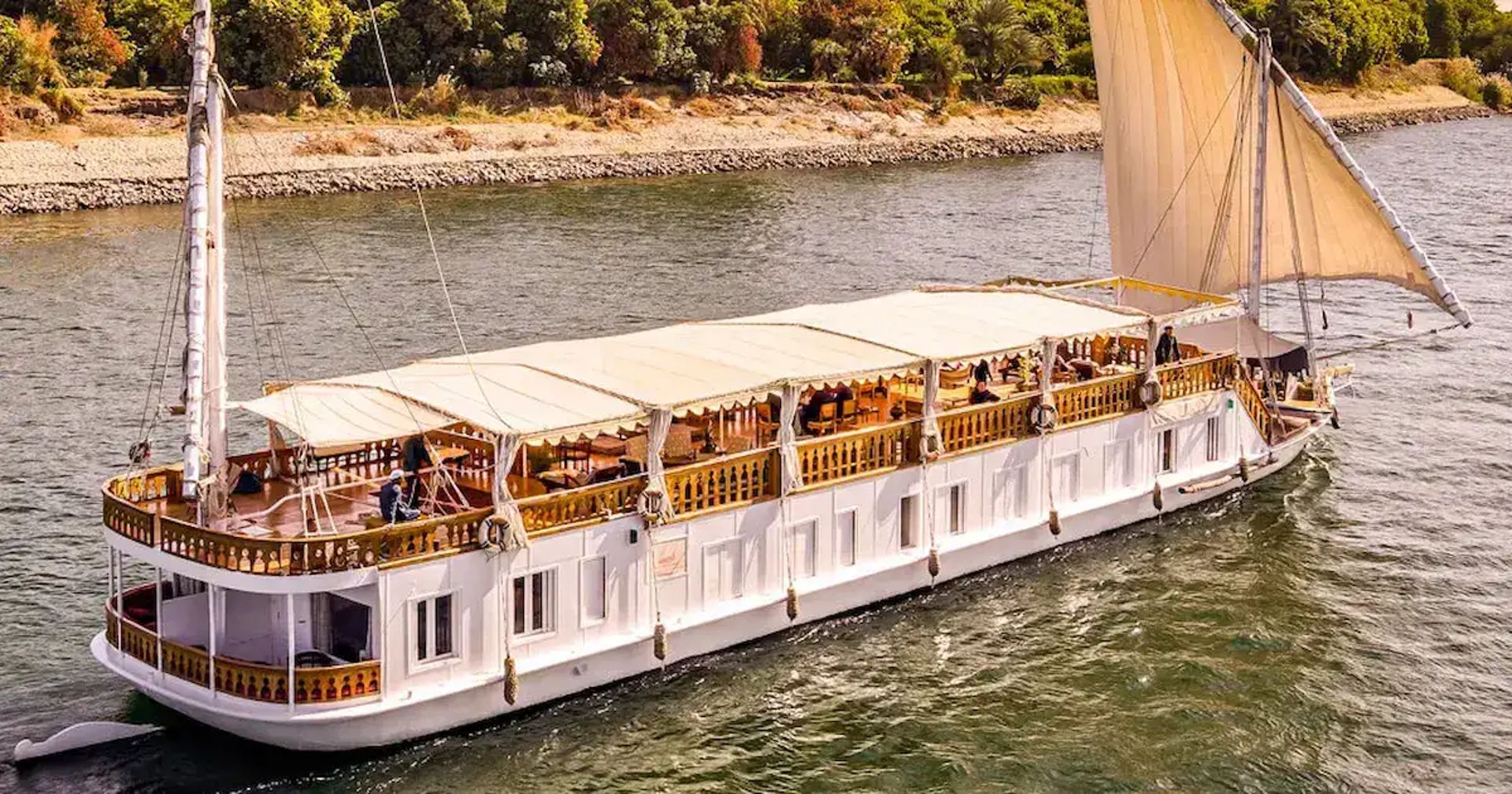
What is a luxury small boat Nile cruise?
A luxury small boat Nile cruise is a private or small-group river journey on a vessel carrying far fewer guests than a big cruise ship. On the Nile, that usually means a dahabiya, a felucca, or a small yacht. Holidaymakers choose this style for quiet sailing, personal service and a slower pace.
A small boat cruise also gives a more open view of the river life around Luxor and Aswan. Dahabiyas are widely considered the top luxury choice, and that matches how most travellers experience them in practice. The boats are small, the mood is calm, and the trip feels far more personal than a large-ship itinerary.
What makes a dahabiya the best luxury choice?
A dahabiya is the strongest luxury option for a small boat Nile cruise because it blends sailing, privacy and comfort. These traditional Egyptian wooden boats usually carry two sails and far fewer cabins than a standard cruise ship. That smaller size makes for a quieter trip and a more flexible daily rhythm.
Dahabiyas typically carry around 8 to 16 guests, which explains why so many couples and small groups prefer them. Cabins are usually elegant, deck space feels open, and meals are commonly served with Nile views. The slower pace is the whole point.
- Quiet sailing, without the feel of a large floating hotel
- A small guest count that keeps the atmosphere personal
- Flexible stops, with the boat able to anchor near quieter riverbanks
- A classic look that suits travellers after character as well as comfort
How do dahabiya, felucca and small yacht cruises compare?
A dahabiya, felucca and small yacht all count as small boat Nile cruises, but they don't feel the same. Dahabiyas are the most polished and private option. Feluccas are simpler sailing boats with a more basic setup. Small yachts sit in between, with more speed and comfort but less old-world charm.
The dahabiya is the gold standard, and that's a fair rule of thumb for anyone comparing small boat Nile cruises. For romance and ease, choose a dahabiya. For a simpler river outing, a felucca works well. For a private, motor-based trip, a small yacht may suit better.
- Dahabiya: best for luxury, privacy and a slow sailing style
- Felucca: best for short, simple river time with a stripped-back feel
- Small yacht: best if you want a private boat with more speed and less sail-driven character
Why do travellers choose small boat Nile cruises?
Travellers choose small boat Nile cruises because the experience feels calm, personal and far less crowded than the big-ship version of the river. The smaller scale helps with privacy, quiet evenings and more personal service, which matters if you want the Nile to feel like part of the trip, not just transport between temples.
Small boats also suit anyone who fancies a slower day. Sit on deck, watch villages pass, and spend more time at temples without the constant movement of a large ship crowd. It works well for couples, families and anyone after a more relaxed route between Luxor and Aswan.
What route and length should you plan?
Most small boat Nile cruises run between Luxor and Aswan and last 4 to 6 nights. That's enough time for the major temple stops and some quieter river sailing. A 7-night round-trip option also suits holidaymakers who want more time on the water.
The route usually takes in Karnak, Luxor Temple, the Valley of the Kings, Edfu, Kom Ombo, the Aswan High Dam and Philae Temple. A longer cruise gives more breathing room, while a shorter cruise suits anyone fitting the Nile into a wider Egypt holiday.
- 4 to 6 nights: the most common small-boat format
- Luxor to Aswan: the classic direction for most cruises
- 7 nights: a better choice for a slower pace and more time on deck
When's the best time for a small boat Nile cruise?
October through April is best, with milder daytime temperatures that make sightseeing far easier. October to December offers comfortable weather, and January to March gives cooler temple visits. Those months are the safest bet for most holidaymakers.
Summer trips can still work, but the heat makes long temple days harder going. If you want the best balance of comfort and clear skies, aim for the cooler season and match your dates to the weather you want, not just the boat style.
What should you expect onboard?
Expect cabins, open deck space, freshly prepared meals, and daily sightseeing with an Egyptologist guide. Some trips include evening music or storytelling on deck. The atmosphere is calmer than on a large ship, and the service feels far more personal.
Expect a slower daily rhythm too. Breakfast is usually followed by a site visit, then lunch or downtime on deck, then another stop or a quiet evening at anchor. That pacing is one reason travellers pick small boats over larger floating hotels.
What should you pack for a small boat Nile cruise?
Pack light and focus on comfort: cotton clothing, a light jacket for cooler evenings, comfortable shoes, sun cream, a hat, sunglasses, and a camera or phone. A book earns its place too, since deck time is part of the appeal.
Egypt's river weather can shift between warm days and cooler nights, especially in the winter months. Closed-toe shoes help at temple sites, and sun protection matters on the open deck. A soft bag is easier to manage than a hard suitcase on a compact boat.
- Light cotton clothes for daytime
- A light jacket for evenings
- Comfortable walking shoes for temple visits
- Sun cream, hat and sunglasses
- Camera or phone, plus a book for slow afternoons
How can you combine a cruise with the rest of Egypt?
A small boat Nile cruise fits neatly into a wider Egypt holiday. Combined with Cairo, Abu Simbel, the Red Sea, or a desert stay, it's a smart way to balance temples, cities and downtime without rushing the river section.
Cairo works well before the cruise if you want the Pyramids of Giza and the Egyptian Museum. Aswan works well afterwards if you want Abu Simbel. A Red Sea finish in Hurghada or Sharm El Sheikh gives you a slower beach ending after the temples.
Plan with us
Luxury small-boat Nile cruises: the dahabiya guide
Compare dahabiya, felucca and small yacht Nile cruises, with practical advice on routes, timing and what to expect onboard.