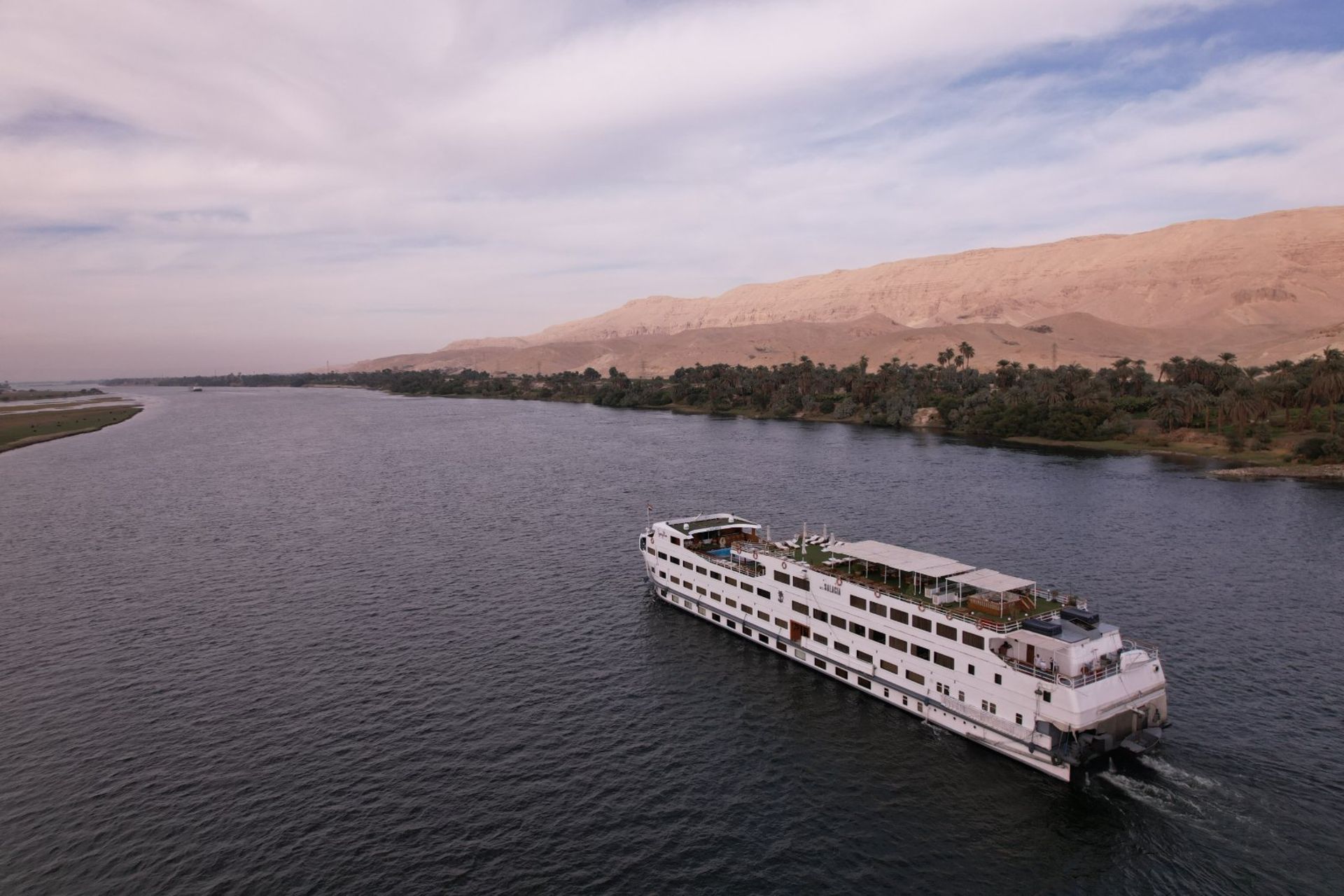
You have narrowed your Nile cruise down to two ships. Both describe themselves as five-star. Both promise Karnak, Edfu, Kom Ombo and Philae. One costs a good deal more than the other, and it is fair to ask what the difference is.
The short answer is that it varies from ship to ship, because the extra money goes to different places on different vessels. Below is how the categories work, where the difference really shows, and how to pick the one that suits the way you like to spend a holiday.
Why five-star tells you so little about a Nile cruise ship
Egypt gives every commercial Nile cruise ship a five-star licence. It is the rating a vessel needs in order to sail, not a verdict on quality, so a modest ship and an outstanding one can carry identical stars.
Hence the second word in the brochure: standard, deluxe, ultra-deluxe, luxury or ultra-luxury. They have no official standing, and companies use them in different ways, but they are pointing at something real.
It is worth knowing, too, that five-star on the Nile does not always mean the five-star standard of service you would expect from a hotel at home. Service, food and upkeep vary from ship to ship, and that gap is one of the real differences between the categories.
A category is really five things at once
When a ship is described as deluxe or luxury, the label is rolling several things together.
- The vessel and its facilities: the layout, the lounges, the pool and sun deck, and how well the ship is looked after.
- The cabins: how much space you have, whether it is a cabin or a suite, and what you can see from the window or balcony.
- The food: anything from a sound, well-run buffet to restaurant dining with real choice.
- The service: how many staff there are, how attentive they are and how personal it feels.
- The management and style: who runs the ship, how consistently, and whether it feels like a big hotel or a boutique.
Ships balance these five differently, which is why the same label can cover quite different vessels.
The extra money goes to different places on different ships
This is what the brochures leave out. Paying more does not always buy the same thing.
- Larger cabins or suites. Some ships spend on space, and a few are suites only.
- Better service and dining. Others keep the cabins more modest and invest in the crew, the kitchen and the attention you are given.
- The whole package. At the top end space, food, service and style all rise together, and the ship feels like a different sort of holiday.
Neither is better in itself. A ship with suites and ordinary service can disappoint someone who hoped to be looked after, and a ship with lovely service and plain cabins can disappoint someone who wanted room to spread out. Decide which of the five matters most to you before you start comparing prices.
The five categories in plain English
This is how we read each label, with the tier we place those ships in.
- Standard: the entry level of five-star on the Nile. A comfortable, practical ship that covers the essentials well, and the most affordable way onto the river. We place these in Essential and Comfort.
- Deluxe: a clear step up in some or all of the five areas, such as better cabins, a more polished ship or more choice at meals. Our Classic tier.
- Ultra-deluxe: the next step, where the improvements run through the whole ship rather than one area. Our Prestige tier.
- Luxury: a different level of quality, and dining is often where guests notice it first. Our Luxury tier.
- Ultra-luxury: the top of the river, where the ship is part of the holiday itself. Our Signature Collection.
| Our tier | Trade label | Suits |
|---|---|---|
| Essential | 5-star standard | First visit, families, groups on a budget |
| Comfort | 5-star standard | First visit, families, groups |
| Classic | 5-star deluxe | Couples, repeat visitors |
| Prestige | 5-star ultra-deluxe | Couples, over-50s |
| Luxury | 5-star luxury | Honeymoons, milestone holidays |
| Signature Collection | Ultra-luxury | Milestone holidays, travellers for whom the ship is part of the journey |
Cabin size, dining and facilities vary by vessel, even within one tier. Treat this table as a guide and check each ship's own page for the details.
Which type of Nile cruise suits you?
- You want to see the temples and keep an eye on the budget: Essential or Comfort. The route is the same as every other tier.
- You would like a nicer cabin and more comfort without paying for the top end: Classic.
- You want to be looked after, or you are celebrating: Prestige or Luxury. Look at the service and dining as well as the cabin.
- Space matters most: ask which ships have suites. That is a different question from asking for a higher category.
- You want the ship itself to be the treat: the Signature Collection.
- Travelling with children: give us their ages. The cabin layout counts for more than the category.
Ships we sell in each tier
All real ships from our collection. Each tier name takes you to the page listing every ship in it, and each ship has its own page with the details.
- Essential and Comfort (5-star standard): Magic I, Nephtis, Royal Princess Amira, Royal Elite
- Classic (5-star deluxe): Amada, Nile Dolphin, Stephanie
- Prestige (5-star ultra deluxe): Nile Excellence, Nile Serenity, Sonesta Moon Goddess
- Luxury (5-star luxury): Sonesta St. George I, Esmeralda
- Signature Collection (ultra luxury): The Oberoi Zahra, The Oberoi Philae, Historia
What stays the same whichever you choose
The itinerary. A classic Luxor to Aswan cruise calls at Karnak and Luxor Temple, the Valley of the Kings, Edfu, Kom Ombo and Philae on every ship, with a licensed Egyptologist guide and the entrance fees for the scheduled visits covered. Full board is included, as are your arrival and departure transfers and the sightseeing.
A cheaper ship does not leave out a temple. Spending more buys you the ship, so it pays to think about which of the five things you will really use.
Five things to ask when comparing two ships
- Is it a cabin ship or a suite ship, and how different is the space?
- Where does the extra price go: space, service or dining?
- What is the dining like, buffet or restaurant, and does it change from evening to evening?
- How many guests does it carry, and how many crew look after them?
- When was it last refurbished, and who manages it?
Dahabiyas and Lake Nasser cruises
A dahabiya is a traditional sailing boat carrying only a small number of guests, which makes it feel private from the first evening. It travels slowly, moors at quiet stretches of bank and suits anyone who prefers peace to a pool bar. Lake Nasser cruises, between Aswan and Abu Simbel, work in the same way. We place both in the same tiers as river ships.
How we help you choose
We are an Egypt-based tour operator, trading since 1988, with offices in Cairo, Luxor, Aswan, Hurghada, Marsa Alam and Sharm El Sheikh. Tell us your dates, who is travelling and which of the five things matters most, and we will send a choice of tiers, each with two named ships or similar. With so many ships sailing, we add alternatives rather than promise one cabin we have not yet held, and we confirm which is available before you pay anything.
Plan with us
Nile cruise ship types explained: from 5-star standard to ultra-luxury
All Nile cruise ships are licensed five-star. What do standard, deluxe, ultra-deluxe, luxury and ultra-luxury mean? Cabin sizes, dining and example ships.